
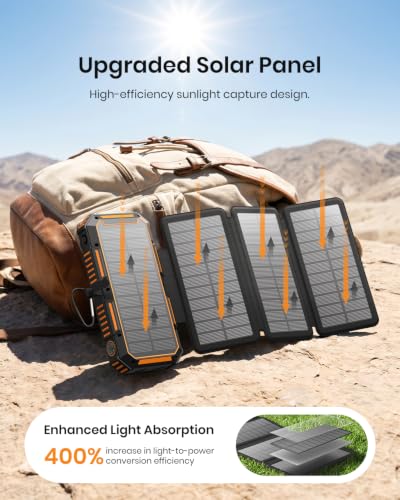
A solar power bank stores power for phones and small devices, with a solar panel that can add charge when sunlight is available. Hikers, campers, and travelers often buy one for backup away from outlets. The best solar power bank balances useful capacity, safe charging, and practical size.
A big capacity number can look reassuring, but it does not promise fast charging or days of power. Tiny built-in solar panels often recharge slowly, and low-quality packs may have unclear capacity claims, weak ports, or poor weather resistance. It is frustrating to reach camp with a nearly empty charger and find that sunlight will not refill it in time. Choosing well means matching the pack to your devices and trip, then treating solar as a backup rather than a sure thing.
I focus on portable power and outdoor gear, where a clear spec can matter more than a flashy claim. For this guide, I compared the listed capacities, charging features, protection ratings, and intended uses of these products. I also considered the gap between a small solar trickle charger and a true power station. This guide prioritizes useful choices and honest limits so you can find the best solar power bank for your plans.
What you’ll learn
- How to judge battery capacity and charging speed for your devices
- Why solar charging is usually best treated as an emergency backup
- Which models suit day hikes, camping trips, and larger power needs
- What to check before buying a rugged or high-capacity charger
In This Article
How To Choose The Best best solar power bank
The right best solar power bank depends on what you need to charge and how long you will be away from an outlet. A huge capacity claim may hide slow output, extra weight, or limited real-world solar charging. Some buyers also assume a small panel can refill a large battery in one sunny afternoon. Before you buy, check the output, ports, weight, protection rating, and charging method. For trips where power matters, consider a power station instead of relying on a pocket-size solar bank.
Match Capacity to Your Devices
Capacity tells you how much stored energy a bank can hold, but the usable amount is lower than the number printed on the case. Phone size, cable losses, and charging habits all affect how many refills you get. For a short hike, a compact 10,000mAh model may be easier to carry than a bulky high-capacity pack. For group camping, a larger bank can make sense, but check its weight and output too. Do not buy by capacity alone; look for clear charging specs and choose enough power for your actual devices.
Check Solar and Wired Charging
A built-in solar panel can help top up a battery outdoors, but its small surface area usually means slow charging. Treat it as a backup, not your main way to fill a large bank. Check whether the product lists solar input details and whether it can also recharge through USB-C. Fast wired input is useful before a trip, while solar can add some power during a long sunny day. Avoid assuming that several small panels will fully charge a high-capacity pack quickly.
Pick Useful Ports and Protection
Look at the ports and cables before you buy. USB-C input and output can simplify charging, while built-in cables reduce what you need to pack. Wireless charging is handy, but it may be slower and less efficient than a cable. For camping, check the stated water-resistance rating and use a dry bag in heavy rain; water resistance is not the same as being waterproof. Choose a rugged, smaller pack for day hikes, or a power station with known watt-hour capacity for larger devices.
Quick Comparison
| Model | Category | Best For | Key Spec | Amazon |
|---|---|---|---|---|
| FEELLE 50,000mAh Solar Power Bank | High Capacity | Backup charging with hand-crank feature | 50,000mAh listed; hand crank | Amazon |
| BLASOUL 49,800mAh Solar Power Bank | Multi-Cable | Travelers who want built-in cables | 22.5W; four built-in cables | Amazon |
| BLAVOR 10,000mAh Solar Power Bank | Compact Outdoor | Day hikes and phone backup | 20W USB-C; IPX5 listed | Amazon |
| SOARAISE 48,000mAh Solar Charger | Multi-Panel | Campers seeking many charging options | Four solar panels; four cables | Amazon |
| Jackery Explorer 300 Power Station | Power Station | Camping and larger device backup | 292Wh; solar panel optional | Amazon |
In-Depth Reviews for best solar power bank
1.
FEELLE 50,000mAh Solar Power Bank
 Check Price on Amazon
The FEELLE solar power bank lists a large 50,000mAh capacity and adds a hand-crank feature for emergency use. That mix may appeal to people who want several ways to seek backup power outdoors. Its headline capacity sounds generous, but real results depend on the phone, cable, and charging losses. Think of the solar panel and crank as supplemental options, not a fast replacement for wall charging.
Its portable-charger format is aimed at trips where access to an outlet may be limited. The hand crank offers a manual option, though it should not be treated as a practical way to refill a large battery. This model may suit campers who value emergency features and can carry a bigger bank. Charge it fully before leaving, and test its ports with your own devices at home.
Check the case, port covers, and included instructions when it arrives. The large capacity claim offers appeal, but weight and charging speed matter just as much. Compare its verified specifications and return terms before paying more for features you may rarely use.
Why It’s Great
- The listed high capacity targets users who want multiple phone top-ups.
- The hand-crank feature offers an extra emergency power option.
- Its solar-charging design suits outdoor backup planning.
- Several charging methods may be useful when outlets are scarce.
- It can serve as a dedicated backup pack for longer outings.
Good to Know
- Hand cranking is not a quick or easy way to refill a large battery.
- Solar charging from a small panel is likely to be slow.
- A 50,000mAh claim does not tell you the usable charge for your device.
2.
BLASOUL 49,800mAh Solar Power Bank
 Check Price on Amazon
The BLASOUL solar power bank lists 49,800mAh capacity, wireless charging, four built-in cables, and 22.5W fast charging. That broad feature set can reduce the need to pack separate cords for different devices. Check the exact cable types and output details before buying, as compatibility matters. Its solar feature can help in bright conditions, but wired charging is the more dependable way to refill it.
Built-in cables make this model appealing for travelers, families, and campers who dislike rummaging through a bag for the right lead. Wireless charging can be handy when a compatible phone is close by, though a cable is often faster. The listed high capacity may mean a larger, heavier pack, so it is better suited to car camping or a roomy day bag than ultralight hikes.
Keep the cables clean and dry, and avoid pulling them sharply from their storage slots. A multi-feature design can offer good value when its ports match your devices. Check the weight, warranty, and product details before relying on it for a long trip.
Why It’s Great
- Four built-in cables can reduce loose accessories in a travel bag.
- The listed 22.5W output supports faster wired charging when compatible.
- Wireless charging adds a cable-free option for supported phones.
- The high listed capacity is aimed at extended use away from outlets.
- Its varied charging methods suit users with several device types.
Good to Know
- Confirm that the built-in cable ends fit your devices.
- Wireless charging may be slower than a wired connection.
- Solar charging should not be counted on to quickly refill this capacity.
3.
BLAVOR 10,000mAh Solar Power Bank
 Check Price on Amazon
The BLAVOR solar power bank lists a 10,000mAh capacity, 20W USB-C charging, wireless charging, and an IPX5 water-resistance rating. It also includes two flashlights, making it a practical outdoor backup for a phone and small essentials. Its smaller capacity is easier to carry than the giant banks in this guide. For many hikers, a useful wired charge matters more than a large number on the case.
This compact format fits day hikes, festivals, and emergency kits where space is tight. Wireless charging can help when you do not want to pack another cable, while USB-C offers a direct option for compatible devices. It is best for one person who needs phone backup, not for powering a group over several days. Keep the charging ports protected from rain and dirt.
A smaller case is easier to store and wipe clean after a dusty outing. The listed water-resistance rating adds reassurance, but it does not make the bank waterproof. Its practical mix of size and features makes it a strong value for short trips and everyday backup.
Why It’s Great
- The 10,000mAh listed capacity keeps the bank more manageable for hikes.
- 20W USB-C charging offers a useful wired option for compatible phones.
- Wireless charging adds flexibility for supported devices.
- The IPX5 rating is suited to splashes, subject to the product instructions.
- Two flashlights add practical utility to a camping kit.
Good to Know
- Its capacity is modest compared with the larger banks in this guide.
- Solar charging is best treated as a slow emergency top-up.
- IPX5 does not mean the device can be submerged in water.
4.
SOARAISE 48,000mAh Solar Charger
 Check Price on Amazon
The SOARAISE solar power bank lists 48,000mAh, four solar panels, wireless charging, four cables, and PD and QC 3.0 fast-charging support. Its many panels and connection options set it apart from simpler pocket banks. Buyers should still check the exact input and output ratings for their devices. Multiple panels can offer more solar area, but sunlight and angle still shape charging results.
Four built-in cables can make it easier to share power across devices without packing a separate set of leads. The feature-rich design may suit campers who carry a larger bag and want flexible backup. It is less suited to minimalist hikers who count every ounce. For reliable charging before a trip, use the listed wired input and save solar charging for sunny outdoor hours.
Keep the panels and cable ends clean, and fold or store them as the maker directs. The multi-panel layout has clear outdoor appeal, though extra features add bulk and do not guarantee fast solar input. Compare its size and tested specs with your actual needs.
Why It’s Great
- Four solar panels provide more panel area than a single-panel design.
- Four built-in cables can simplify charging for several devices.
- PD and QC 3.0 support offer fast-charge options when compatible.
- Wireless charging gives supported phones another way to connect.
- The flashlight feature can be useful in a camping kit.
Good to Know
- A 48,000mAh listed capacity can make this pack bulky to carry.
- Solar charging speed still depends on direct sun and panel position.
- Check cable types and charging ratings for your devices before buying.
5.
Jackery Explorer 300 Power Station
 Check Price on Amazon
The Jackery Explorer 300 is a portable power station with a listed 292Wh capacity, not a pocket-size solar power bank. It is designed to supply power to larger devices than a phone charger can handle, subject to its output limits. A compatible solar panel is optional, so check the package contents. Its watt-hour rating makes it easier to compare with power stations than with banks rated in milliamp-hours.
This unit suits car campers, travelers, and people who want backup for small electronics at a campsite or during an outage. It takes more room than a pocket bank, so it is not the best fit for a long hike on foot. Check each device’s wattage and the station’s port limits before plugging in. For solar use, plan for a compatible panel and suitable weather.
The station-style case is made for transport and repeated outdoor use, but it still needs careful handling and dry storage. Because the solar panel is optional, include that extra cost in your budget. It offers more flexible power than a phone bank when your needs justify the size.
Why It’s Great
- The 292Wh rating is useful for comparing power-station capacity.
- It can support a broader range of small electronics than a phone bank.
- The solar panel is optional, so buyers can choose their charging setup.
- Its station format suits car camping and home backup planning.
- It is a practical step up when phone-sized banks are not enough.
Good to Know
- This is larger and heavier than a typical portable phone power bank.
- A compatible solar panel is not included in the stated product title.
- Check the current listing for battery chemistry and device output limits.
Final Thoughts: The Verdict
My personal top pick is the BLAVOR 10,000mAh Solar Power Bank. Its listed 20W USB-C output, compact capacity, wireless charging, and outdoor-focused features make it a balanced best solar power bank for day hikes and phone backup. It is still wise to charge it by cable before a trip, since its solar panel is a backup, not a fast refill method.
For built-in cables and a much larger listed capacity, consider the BLASOUL 49,800mAh Solar Power Bank. The Jackery Explorer 300 is a better fit for car camping and larger device needs, while the FEELLE and SOARAISE offer high-capacity feature sets. Compare size, ports, and verified specs, then choose the best solar power bank for your devices, trip, and budget.