
Solar inverters turn the direct current from solar panels or batteries into the alternating current that household devices use. Homeowners, cabin users, and off-grid planners buy them for backup power or greater energy control. This guide to the best solar inverter brands compares five hybrid models with different power levels and system needs.
A poor inverter match can turn a promising solar setup into a frustrating one. Buyers may overlook battery voltage, mistake peak power for continuous power, or assume a unit can connect to a home panel without added equipment. Some listings also use technical terms that need careful checking, including certifications and solar input limits. The result can be unexpected shutdowns, extra costs, or equipment that does not suit the home. Choosing carefully matters: check the full manual, confirm compatibility, and use a qualified installer for household wiring.
I compared the specifications supplied for these models, focusing on power, battery voltage, output type, charging features, and stated expansion options. I also considered where each design may fit, from a small cabin to a larger backup plan. Product claims can change, so confirm current manuals, certifications, and warranty terms before buying. This guide to the best solar inverter brands puts fit, safety checks, and clear trade-offs first.
What you’ll learn
- How inverter output and battery voltage affect system fit
- Which models offer 120V or split-phase 120/240V output
- What to check before relying on solar charging or parallel use
- How to match a hybrid inverter to a cabin or home backup plan
In This Article
How To Choose The Best best solar inverter brands
The right inverter keeps a solar system useful when the sun dips or the grid fails. A mismatch can mean weak output, battery trouble, or a costly replacement. Do not choose by the largest watt number alone: listings may mix continuous and surge power, and a stated certification still needs proof in current product documents. Check your loads, battery type, wiring plan, and local rules first. The best solar inverter brands for one cabin may not suit a whole home, so compare real system needs before you buy.
Match Output to Your Loads
List the devices you need to run at the same time, then check their running and startup power. Motors, pumps, and fridges can draw more power when they start. Compare that need with the inverter’s continuous rating, not only a larger peak figure. Also confirm whether you need 120V or 120/240V split-phase output. A 120V model may work well for a cabin or a small backup circuit, while split phase can suit certain home loads. Never assume a larger watt rating alone means a unit can power every circuit.
Check Battery and Solar Compatibility
Start with the battery bank’s voltage and chemistry. A 24V inverter cannot simply replace a 48V model, and lithium batteries may need supported settings or communication links. Next, compare the solar array’s open-circuit voltage and current with the inverter’s input limits in its manual. A high MPPT amp rating does not tell the whole story. It does not by itself confirm how many panels you can connect. Check whether the model supports battery-free operation if that matters to you, and never guess at wiring or settings.
Review Installation, Safety, and Support
A hybrid inverter is part of a high-energy electrical system, not a plug-in gadget. Check the installation guide, required breakers, wire sizes, grounding, temperature limits, and permitted use. If a listing says UL1741, verify the exact model and current certification documents rather than relying on the claim alone. Ask about warranty length, service access, and replacement parts before purchase. Parallel support also needs compatible units and setup rules. A qualified solar electrician can confirm whether the design meets local code and safely fits your home.
Quick Comparison
| Model | Category | Best For | Key Spec | Amazon |
|---|---|---|---|---|
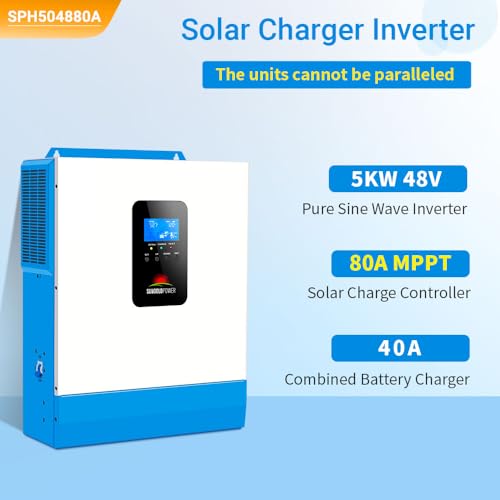
| SUNGOLDPOWER 5000W 48V All-in-One | Off-grid | Cabins and 48V backup systems | 120V; 80A MPPT; no parallel | Amazon |
| SUMRY 4000W 24V Hybrid Inverter | Hybrid | Smaller 24V systems | 4000W; 120V pure sine output | Amazon |
| SUMRY 3600W 24V Hybrid Charger | Battery flexible | Compact backup or storage | 120A MPPT; 110V output | Amazon |
| HumsiENK 8000W 48V Split-Phase | High capacity | Larger home backup plans | 120/240V; parallel up to 6 units | Amazon |
| POWLAND 12000W 48V Hybrid Inverter | High output | Large split-phase systems | 120/240V; dual MPPT; Wi-Fi | Amazon |
In-Depth Reviews for best solar inverter brands
1. SUNGOLDPOWER 5000W 48V Solar Inverter

This SUNGOLDPOWER all-in-one inverter combines a stated 5000W rating with 48V battery input and 120V pure sine wave output. Its listed 80A MPPT solar charger and 40A AC charger support more than one charging path. For shoppers comparing the best solar inverter brands, this bundle may simplify an off-grid system plan.
The single-unit design brings inverter and charging functions together, which may reduce the number of separate devices to plan around. Its 120V output suits compatible loads, while the 48V input calls for a matching battery bank. It may fit a cabin, backup setup, or off-grid home that does not need parallel operation.
The product is listed as an all-in-one unit, but installation still needs suitable space, airflow, wiring, and protection. Confirm the case dimensions, manual, warranty, and safety documents before buying. For a 48V, 120V setup, its combined functions may offer useful value.
Why It’s Great
- Combines inverter and two charging functions in one listed unit.
- 80A MPPT rating is clearly stated for solar charging.
- 40A AC charger adds a listed grid or generator charging path.
- 48V input can suit a properly designed 48V battery bank.
- Pure sine wave output is designed for compatible AC loads.
Good to Know
- The listing says parallel operation is not supported.
- Output is 120V, not 120/240V split phase.
- Verify continuous versus surge power and the full solar input limits in the manual.
- Check the exact UL1741 claim and certification documents before relying on it.
2. SUMRY 4000W 24V Hybrid Solar Inverter

The SUMRY hybrid inverter is listed at 4000W, with 24V DC input and 120V pure sine wave AC output. Those headline details make it a possible fit for a smaller battery system that needs household-style power. Buyers comparing the best solar inverter brands should confirm its charging ratings and limits in the current manual.
Its 24V design may suit a compact cabin or backup plan that already uses a matching battery bank. Before purchase, check the unit’s solar input, battery chemistry settings, and transfer features, as these details are not given in the supplied product title. It is best for buyers who can verify those needs first.
A hybrid label can mean several functions, so review what is included before comparing price. Confirm the casing, cooling needs, warranty, and installation rules. Its value depends on verified compatibility with your panels, battery, and intended loads.
Why It’s Great
- The stated 4000W rating gives buyers a clear starting point for load planning.
- 24V input may work for an existing compatible battery bank.
- 120V pure sine output suits compatible 120V equipment.
- Hybrid design may consolidate functions, subject to manual confirmation.
- Could be a practical option for smaller off-grid or backup projects.
Good to Know
- The supplied title does not state MPPT current or solar input limits.
- Confirm which battery types and charging modes are supported.
- It is not listed as a 120/240V split-phase model.
- Check whether 4000W is continuous or a peak rating.
3. SUMRY 3600W 24V Hybrid Solar Charger

This SUMRY hybrid inverter is listed at 3600W and uses 24V DC input with 110V AC output. Its stated 120A MPPT controller is a key feature for buyers sizing a solar charging system. The product title also mentions battery-free or battery-supported use, a point to verify in its manual before planning.
The model may suit a compact backup or energy storage system where its 110V output matches the intended equipment. Its listed battery flexibility could help some designs, but does not remove the need to check solar conditions, approved settings, or load limits. It is for buyers who value MPPT capacity and can confirm fit.
Check the included hardware, cooling needs, case dimensions, and support terms before installation. The value rests on whether the 120A controller and operating modes match your actual array. Treat battery-free use as a feature to verify, not an assumption.
Why It’s Great
- The listing states a 120A MPPT controller.
- 3600W rating can fit some compact power plans.
- 24V input may match an existing 24V system.
- Pure sine wave output is stated in the product title.
- Battery-free and battery-supported operation are both mentioned in the listing.
Good to Know
- The stated AC output is 110V, so check device and wiring compatibility.
- Confirm the precise battery-free operating limits with the manufacturer.
- The supplied title does not specify maximum PV voltage or solar wattage.
- Verify whether the 3600W figure is continuous or peak power.
4. HumsiENK 8000W 48V Split-Phase Inverter

The HumsiENK hybrid inverter is listed at 8000W with 48V battery input and 120/240V split-phase output. Its title also states a 10000W MPPT solar charger, 160A charging, and parallel support for up to six units. These figures make it a high-capacity candidate among the best solar inverter brands.
Split-phase output may fit systems that need compatible 120V and 240V loads, but the full installation must support that design. The listing also claims UPS switching of 10ms or less. This model may suit a larger off-grid or home backup plan, provided a qualified installer confirms the loads and connection method.
A unit at this stated capacity needs careful mounting, airflow, wiring, and overcurrent protection. Confirm the exact manual, parallel rules, warranty, and certification documents before purchase. Its value may appeal to buyers who need split phase, but only when the system is designed to match.
Why It’s Great
- The listing states 120/240V split-phase output.
- 48V input is suited to a compatible 48V system design.
- The title lists 8000W output and a 10000W MPPT solar charger.
- Parallel operation for up to six units is stated.
- The listed UPS switching time may appeal to backup users.
Good to Know
- Confirm the meaning and limits of the stated 160A rating.
- Parallel setups require compatible units and careful configuration.
- Verify the UL1741 claim for the exact model and current documents.
- High-power home connections require qualified design and installation.
5. POWLAND 12000W 48V Hybrid Inverter

POWLAND lists this hybrid inverter at 12000W, with 48V DC input and 120/240V split-phase AC output. The product title also names Wi-Fi, battery-free design, dual 200A MPPT, and parallel support for up to six units. This high-output feature set stands out among the best solar inverter brands reviewed here.
Split-phase output may suit larger systems with compatible 120V and 240V loads. Wi-Fi may offer monitoring, but check what the app tracks and whether internet access is needed. The listing mentions 48V LiFePO4 and lead-acid batteries, as well as battery-free use. Confirm supported modes and limits before choosing it.
This is a substantial system component, so plan for safe mounting, ventilation, wiring, and service access. Verify the actual PV input limits, warranty, certification, and parallel setup rules. Its value is strongest for buyers who need the capacity and can support a qualified installation.
Why It’s Great
- The listing states 120/240V split-phase output.
- Dual MPPT is named for solar charging.
- Wi-Fi monitoring is listed as a feature.
- The product title states support for parallel use up to six units.
- 48V battery support is listed for LiFePO4 and lead-acid systems.
Good to Know
- Verify the actual solar input limits; an MPPT current label alone is not enough.
- Battery-free operation may have specific limits and should be checked in the manual.
- Confirm the stated UL1741 certification for the exact model.
- High output and parallel use require professional system design.
Final Thoughts: The Verdict
My personal top pick is the SUNGOLDPOWER 5000W 48V Solar Inverter for its stated 80A MPPT, 40A AC charger, and clear fit for a 48V off-grid plan. It offers a useful balance for cabins and backup systems, though its 120V output and lack of parallel support may not fit every home. For larger loads, the HumsiENK 8000W Split-Phase Inverter is a runner-up with stated 120/240V output and expansion support. The POWLAND may suit higher-output designs, while SUMRY models suit select 24V systems. Among the best solar inverter brands here, choose by verified specs, system fit, and budget.
2 thoughts on “Best Solar Inverter Brands: How To Choose The Right One”
Comments are closed.