
A portable solar charger stores power for phones and other small devices, and some models can also collect energy from sunlight. It suits campers, hikers, travelers, and anyone planning for outages. People buy one for backup power and fewer worries when a wall outlet is out of reach.
A big battery number can look reassuring, but it does not tell the whole story. Some solar banks recharge very slowly from their small built-in panels, while others feel bulky or lack the ports a family needs. A common mistake is expecting a pocket-sized charger to power a laptop or refill itself quickly on a cloudy trail. That can leave a phone dead when maps or emergency calls matter most. Choosing the right setup means checking charging speed, real use, and limits before you pack it.
I focus on practical outdoor power and compare product claims, connection options, stated capacity, and intended use. For this guide, I reviewed the supplied product details and considered where each design may help or disappoint, rather than treating marketing claims as proven test results. My aim is to help readers choose the best portable solar charger for their gear, trip, and budget.
What you’ll learn
- How to match battery size and charging ports to your devices
- Why built-in solar panels are best treated as backup charging
- Which picks suit day hikes, camping, and larger power needs
- What limits and product claims to check before buying
In This Article
How To Choose The Best Portable Solar Charger
The best portable solar charger is the one that can serve your devices when you need it, not the one with the biggest number on its box. Check the ports, charging speeds, size, and actual power needs of your gear. Small built-in panels may add charge in bright sun, but they are rarely a fast replacement for a wall charger. Avoid choosing by claimed capacity alone. Think about your trip, how often you can recharge, and whether you need a pocket-size battery or a power station.
Match Battery Capacity to Your Devices
Capacity gives a rough sense of how much stored energy a charger may hold, but real output is lower than the battery’s headline number because conversion uses some energy. Check your phone or device needs and allow room for losses. A high-capacity bank can help on long trips, yet it may be heavy and take longer to refill. For a day hike, a smaller power bank may be easier to carry. Do not assume a solar bank can quickly refill itself; use its built-in panel as a backup, not your main charging plan.
Check Ports, Cables, and Charging Speed
A useful charger must work with the devices you bring. Look for the right USB ports, cable types, and stated charging speeds, then confirm that your phone supports them. Built-in cables can cut clutter, but they may not fit every device or be easy to replace. Wireless charging is handy when cables are awkward, though it can be slower and less efficient. A best portable solar charger for a group should offer enough ports to share power. Avoid assuming that a fast-charge label guarantees the same speed for every phone.
Choose the Right Size and Solar Setup
Think about how you will carry and recharge the unit. A compact bank is easier to pack, while a larger power station can run more types of devices but weighs more. Small solar panels built into power banks usually collect energy slowly, and shade or clouds can reduce output. A separate folding panel gives more surface area but adds bulk. Check the product’s stated weight, outlets, and solar input details before buying. For phones on a short outing, choose portability; for camping gear, consider a power station and a larger panel.
Quick Comparison
| Model | Category | Best For | Key Spec | Amazon |
|---|---|---|---|---|
| BLASOUL Solar Power Bank | High-Capacity Bank | Charging several phones | 49,800mAh claimed; 22.5W; built-in cables | Amazon |
| SOARAISE Solar Power Bank | Multi-Panel Bank | Campers wanting cable and panel options | 48,000mAh claimed; four solar panels and cables | Amazon |
| Portable Solar Generator 300W | Power Station | Camping with multiple device types | 280Wh battery; 300W rating; 60W panel included | Amazon |
| Nymzixt Solar Power Bank | Compact Bank | Day trips and phone backup | 20,000mAh claimed; three built-in cables | Amazon |
| FEELLE Solar Power Bank | Emergency Bank | Backup charging and emergency kits | Magnetic charging and hand crank | Amazon |
In-Depth Reviews for the Best Portable Solar Charger
1.
BLASOUL 49,800mAh Solar Power Bank
 Check Price on Amazon
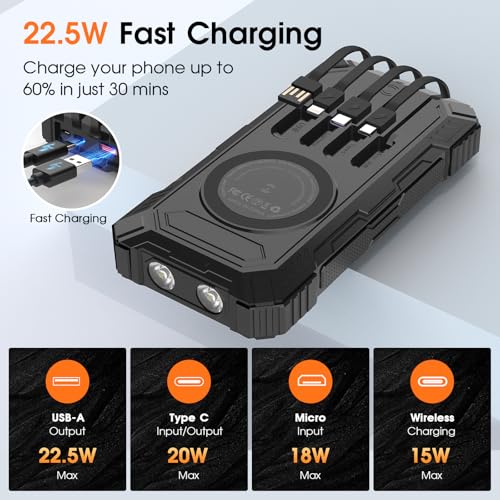
The BLASOUL bank lists a 49,800mAh capacity, 22.5W charging, wireless charging, and four built-in cables. Those features aim to reduce extra gear and keep several devices supplied. Its solar panel offers a backup way to collect energy, but sunlight charging can be slow. The listed fast-charge rate makes it a flexible option for phone users.
Built-in cables can make camp setup simpler and help when a separate cord is missing. The bank is best suited to travelers and campers who want a single unit for several phones. Its claimed high capacity may add weight, so check the current listing for dimensions and weight before packing it for a long hike.
Keep the ports and cables clean and dry, and follow the maker’s care instructions. The feature list is broad, but the value depends on verified capacity, safety details, and actual weight. Treat solar charging as a backup, and compare the current price with your daily device needs.
Why It’s Great
- Four built-in cables can reduce loose accessories.
- The listing claims up to 22.5W wired charging.
- Wireless charging offers another way to top up a compatible phone.
- High claimed capacity may suit multi-day phone use.
- Useful mix of charging options for travel and camp.
Good to Know
- The stated capacity and charging speed are product claims, not independently verified test results.
- A small built-in solar panel is unlikely to refill a large bank quickly.
- The product title does not state its weight or dimensions; check before hiking.
2.
SOARAISE 48,000mAh Solar Power Bank
 Check Price on Amazon
The SOARAISE bank lists a 48,000mAh capacity, four built-in cables, wireless charging, and four solar panels. It also advertises PD and QC 3.0 fast charging. The extra panel area may collect more sun than a single small panel, though real output still depends on direct light and conditions. It stands out for offering several charging methods in one unit.
This design may suit campers who want to leave fewer cables at home and have a backup way to gather sunlight. Its several panels need room and good exposure, so set it in direct sun rather than expect much power inside a tent. It is likely more useful at a campsite than on a fast, light hike.
Brush off dust and keep the panel surfaces clear for better exposure. The listed features offer flexibility, but the size, weight, and verified battery output are not given in the product title. Review those details and the care guidance before deciding whether the price fits your trips.
Why It’s Great
- Four panels provide more solar collection area than a single panel design.
- Four built-in cables can help reduce cable clutter.
- PD and QC 3.0 are listed for compatible devices.
- Wireless charging adds a cable-free option.
- Large claimed capacity may suit longer outings.
Good to Know
- Solar output will vary with sun angle, shade, and weather.
- The product title does not confirm unit weight or dimensions.
- A 48,000mAh claim does not mean that much energy reaches connected devices.
3.
300W Portable Solar Generator with 60W Panel
 Check Price on Amazon
This portable power station lists a 280Wh battery, a 300W output rating, and a 60W solar panel. It also names a 110V pure sine wave AC outlet, USB QC 3.0, and DC output. That mix can support more device types than a phone bank. The stated figures are useful for planning, but check device draw and the maker’s limits.
This is a better fit for a campsite, RV, or van than a pocket or daypack. The separate solar panel needs space and a sunny spot, while the AC outlet can serve compatible small electronics within the station’s rating. It may help campers who need flexible outlets, but it is not a substitute for a home backup system.
Keep the station and panel dry, clean, and stored as directed. A panel is included, which can add value for planned outdoor use, but the unit will be less convenient to carry than a small bank. Check weight, charging time, and device compatibility before purchase.
Why It’s Great
- A 280Wh battery is stated for comparing energy needs.
- The 300W rating and AC outlet add device flexibility.
- A 60W solar panel is included in the listed package.
- USB, DC, and AC outputs support different device types.
- A strong option for car camping and van trips.
Good to Know
- This power station is bulkier than a phone-sized portable solar charger.
- The product title does not provide the unit’s weight or full port count.
- Actual runtime depends on device power draw and conversion losses.
4.
Nymzixt 20,000mAh Solar Power Bank
 Check Price on Amazon
The Nymzixt listing describes a 20,000mAh bank with three built-in cables, wireless charging, and a bright two-LED flashlight. It is aimed at phones and other small devices rather than larger gear. The lower stated capacity may make it easier to carry than the biggest banks, while its solar feature offers a backup option for outdoor use.
This model may suit day hikes, travel days, and emergency kits where a light source and phone backup are useful. Built-in cables can make it easy to share with common devices, but confirm that the connectors match your gear. As with other small-panel banks, do not count on fast solar recharging during a short break.
Keep the flashlight lens and charging points free of dirt, and store the unit away from moisture. Its listed combination of cables and light may offer practical value in a compact kit. Check the current listing for weight, compatible charging speeds, and warranty details before choosing it.
Why It’s Great
- Three built-in cables can simplify phone charging.
- The 20,000mAh claim is more modest than the largest banks.
- Wireless charging is listed for compatible phones.
- Two LED lights may help around camp or during outages.
- Useful feature mix for a day-trip emergency kit.
Good to Know
- The product title does not state a wired charging speed.
- Wireless charging may be slower than a direct cable connection.
- Solar charging should be treated as a slow backup, not the main recharge method.
5.
FEELLE Solar Bank with Hand Crank
 Check Price on Amazon
The FEELLE listing highlights magnetic portable charging and a hand crank, with solar charging included in the product name. Those features focus on backup options when normal power is hard to reach. The supplied title does not state battery capacity, output speed, or panel size, so shoppers should check the live listing before comparing it with high-capacity banks.
Magnetic charging may be handy for a compatible phone, while the crank offers a manual option in an emergency. A hand crank is best viewed as a way to add limited emergency power, not as a quick replacement for a wall charger. This design may suit an emergency kit more than daily use or a long hike.
Keep the crank and charging surfaces clean, and follow the maker’s storage guidance. Without a stated capacity in the supplied details, its value is hard to compare on price alone. Check capacity, device compatibility, and safety information before relying on it as your main portable solar charger.
Why It’s Great
- A hand crank provides an extra manual charging method.
- Magnetic charging may be convenient for compatible phones.
- Solar charging offers another potential backup method.
- Its emergency-focused features may suit a preparedness kit.
- Several power options can be useful during an outage.
Good to Know
- The supplied product title does not state battery capacity.
- Hand-crank power is generally limited and requires effort.
- Confirm phone compatibility and charging speed before purchase.
Final Thoughts: The Verdict
My personal top pick is the BLASOUL Solar Power Bank for its mix of built-in cables, wireless charging, and a stated 22.5W output. It looks like a flexible phone bank for travel, but its capacity and solar performance should be treated as listing claims. For a campsite with more power needs, the 300W Portable Solar Generator is a better fit, thanks to its listed 280Wh battery, AC outlet, and included panel.
The SOARAISE bank suits campers who want multiple panels and cables, while the Nymzixt is a more modest phone-backup choice. FEELLE may appeal to emergency-kit buyers who value a hand crank, though its listed capacity needs checking. The best portable solar charger depends on what you need to power, how far you will carry it, and how you can recharge it. Check weight, output, and current listing details before you buy.