
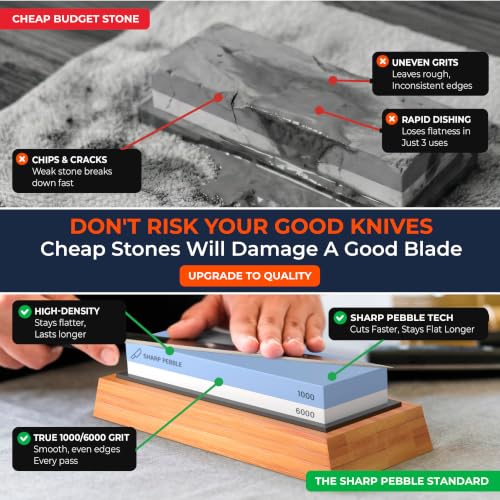
For most beginners, the Sharp Pebble 1000/6000 grit whetstone offers the easiest path to sharp knives.
A dull kitchen knife can slip, crush food, and make simple prep feel hard. A good sharpening stone solves that problem without needing a large electric sharpener. I looked at beginner-friendly grit ranges, included tools, stone control, and day-to-day value to find the best beginner sharpening stone options. The right pick should help you learn a steady angle, repair a dull edge, and polish it with less stress.
See the differences between my top picks at a glance.
| Stone | Grit Range | Best For | Included Support | Beginner Ease |
|---|---|---|---|---|
| Sharp Pebble | 1000/6000 | Routine kitchen sharpening | Stone holder and angle guide | Excellent |
| Intelitopia | 400/1000 and 3000/8000 | Complete sharpening work | Strop, flattening stone, bases, guide | Very good |
| KEENBEST | 400/1000 | Dull knives and basic repairs | Non-slip rubber base | Good |
| HMPLL | Four-sided grit set | Users who want more grit choices | Multi-grit stone system | Good with practice |
| Bora | Coarse/fine | Simple bench sharpening | Basic two-grit stone | Good for simple jobs |
Sharp Pebble 1000/6000 Whetstone

The Sharp Pebble 1000/6000 stone is a strong fit for a first sharpening kit. Its medium 1000 grit can restore a tired kitchen edge, while the 6000 grit can smooth and polish that edge. This two-step layout keeps the process simple. You do not need to sort through many stones before you begin.
I like this grit pair for cooks who want to learn hand sharpening at home. The stone holder helps keep the work surface more stable, and the angle guide can help new users build better habits. As with any water stone, you should follow the care directions and keep the stone flat over time. It works best when you use light pressure and steady strokes.
Pros:
- Useful 1000/6000 grit combination for common kitchen knives
- Simple setup for new sharpening users
- Fine side helps polish a working edge
- Included support parts can improve control
- Good choice for routine knife maintenance
- Easy grit progression to remember
Cons:
- May not be the fastest choice for very damaged blades
- Needs proper soaking or wetting based on the care instructions
- Requires flattening after repeated use
What Amazon Buyers Are Saying
Amazon buyers commonly like this set because it gives them a clear starting point. Many users find the two grits useful for kitchen knives and say the stone helps them get better results with practice. The compact setup also appeals to people who want a manual tool instead of an electric sharpener.
The main concerns tend to involve learning technique. Some beginners expect instant results and need time to hold a steady angle. Others point out that the stone needs care and should not sit wet after use. These are normal points for water stones, not signs that the basic design cannot work.
My Recommendation
I recommend the Sharp Pebble to most first-time users who want a balanced, easy-to-understand kit. It is especially useful for common stainless steel kitchen knives that need regular sharpening rather than major repair. I rate it highly because the grit pair supports both sharpening and finishing without adding too much complexity.
| Category | Rating |
|---|---|
| Beginner Control | 4.5/5 |
| Grit Versatility | 4.5/5 |
| Routine Performance | 4.5/5 |
| Included Support | 4/5 |
| Overall Rating | 4.5/5 |
Intelitopia Complete Sharpening Set
 complete beginner sharpening stone set”>
The Intelitopia set is made for beginners who want more than one basic stone. It includes 400/1000 and 3000/8000 grit surfaces, so you can move from repair to sharpening and then to polishing. The lower 400 grit can help with a very dull edge, while the higher grits support a smoother finish. This makes the kit more complete than a simple two-sided stone.
The set also includes a leather strop, flattening stone, bamboo base, rubber bases, and an angle guide. Those extras can reduce the number of separate tools you need to buy. Still, more parts mean more setup and more choices. I would tell a new user to start with the 1000 grit, learn the angle, and only then explore the other surfaces.
Pros:
- Wide grit range for repair, sharpening, and polishing
- 400 grit gives more help with very dull edges
- 8000 grit supports fine edge finishing
- Flattening stone helps maintain the working surfaces
- Leather strop can refine the edge after stone work
- Multiple rubber bases offer added setup support
- Angle guide may help new users learn hand position
Cons:
- Large kit may feel complex for a first-time user
- Extra parts require more storage and care
- Very fine grits do not replace good sharpening technique
What Amazon Buyers Are Saying
Amazon customers often value the number of items in this kit. Buyers who sharpen several knives tend to like having a coarse option, medium option, finishing surfaces, and a strop in one package. The included accessories also receive attention from people who want a more guided learning experience.
Some customer feedback points to a learning curve caused by the many grit choices. A beginner may need to read the instructions and plan the order of use. As with other water stones, users also need to dry the stones well and keep the surfaces in good shape. The set offers broad value, but it rewards patience.
My Recommendation
This is my pick for a beginner who wants a complete sharpening station instead of a single stone. It can grow with your skills, but it may be more than you need if you only sharpen one or two kitchen knives. I consider it a good value when you plan to use the coarse and fine options over time.
| Category | Rating |
|---|---|
| Grit Range | 5/5 |
| Learning Support | 4.5/5 |
| Accessory Value | 4.5/5 |
| Setup Simplicity | 3.5/5 |
| Overall Rating | 4.5/5 |
KEENBEST 400/1000 Whetstone
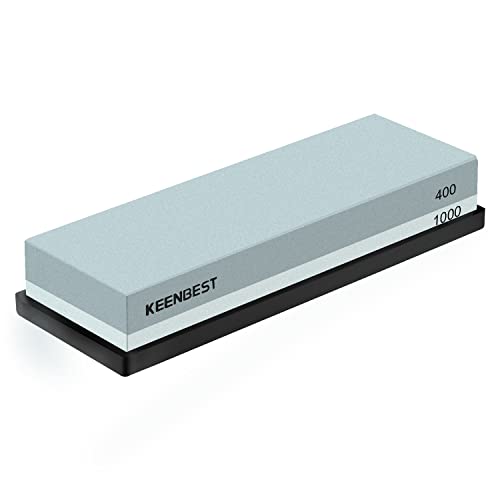
The KEENBEST stone uses a practical 400/1000 grit pairing. The coarse side can help reshape a blunt or neglected edge, while the 1000 side handles normal sharpening work. This makes it a useful choice for older kitchen knives that need more attention. It has fewer steps than a full polishing kit.
I see this as a basic sharpening tool for people who care more about function than a mirror finish. The non-slip rubber base can help the stone stay in place during use. You still need to work on a stable counter and use controlled strokes. A 1000 grit finish can be very useful for daily cooking, even without a high-polish side.
Pros:
- 400 grit can address dull and neglected knife edges
- 1000 grit suits common sharpening tasks
- Simple two-sided design is easy to understand
- Non-slip base can improve work surface control
- Good fit for basic kitchen knife maintenance
- Fewer components make storage simple
Cons:
- Does not include a high finishing grit
- Coarse grit can remove metal quickly if used with heavy pressure
- Users who want a polished edge may need another stone or strop
What Amazon Buyers Are Saying
Amazon buyers often point to the simple design as a benefit. People who want to revive dull household knives appreciate the coarse side, while the 1000 side gives them a useful next step. The non-slip base also matters to users who want a less fussy setup.
The common limitation is the lack of a fine polishing surface. Some users want a sharper-looking finish and may later add a higher grit stone. Buyers also need to learn how much pressure to use on the 400 side. Heavy pressure can create uneven results or remove more steel than needed.
My Recommendation
I recommend the KEENBEST for a budget-minded beginner with dull kitchen knives. It is a focused tool, not a complete polishing system. Choose it if you want coarse repair and medium sharpening in one stone, and do not mind adding a finishing step later.
| Category | Rating |
|---|---|
| Basic Sharpening | 4/5 |
| Coarse Edge Repair | 4.5/5 |
| Ease of Use | 4/5 |
| Finishing Ability | 3/5 |
| Overall Rating | 4/5 |
HMPLL Four-Sided Sharpening Stone
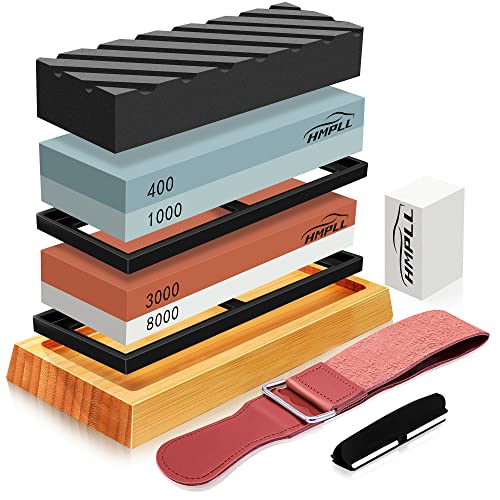
The HMPLL sharpening stone set gives users four grit surfaces in one system. That range can help with repair, regular sharpening, and edge refinement. It gives a beginner room to test different finishes as their skills grow. However, the extra surfaces also make it important to know which side to use and when.
This type of stone can suit a home cook who sharpens different knives at different times. A rougher face can help with a damaged edge, while a finer face can make the final edge feel smoother. I would use light pressure on the fine sides and check the blade often. Good results depend on keeping the stone wet as directed and maintaining a steady angle.
Pros:
- Four grit surfaces provide useful sharpening flexibility
- Can handle repair and routine edge work
- Offers a path for skill growth
- One system may replace several basic stones
- Fine surfaces can improve edge smoothness
- Useful for households with several knife types
Cons:
- More grit choices may confuse complete beginners
- Users must track each surface and sharpening order
- Small grit faces may require careful positioning during use
What Amazon Buyers Are Saying
Amazon buyers commonly like the range of surfaces and the chance to complete more sharpening steps with one set. Users who already know basic stone technique often see the multi-grit layout as a useful feature. Some beginners also like being able to move from a rough side to a fine side without buying another kit at once.
The main concern is the added learning curve. New users may not know when to stop on one grit or move to the next. Some buyers also mention that multi-sided systems need careful cleaning and storage. I would not choose this set only because it has more numbers; I would choose it if you plan to learn the full process.
My Recommendation
The HMPLL set is a reasonable choice for a patient beginner who wants several grit levels. It is less direct than a basic 1000/6000 stone, but it offers more room to experiment. I recommend it for users who are willing to read the guide and practice on an older knife first.
| Category | Rating |
|---|---|
| Grit Flexibility | 4.5/5 |
| Skill Growth | 4/5 |
| Beginner Simplicity | 3.5/5 |
| Repair and Finishing | 4/5 |
| Overall Rating | 4/5 |
Bora 6-Inch Aluminum Oxide Stone
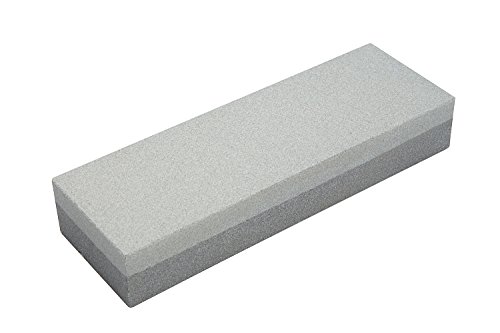
The Bora six-inch sharpening stone takes a more basic approach. It uses aluminum oxide and offers coarse and fine sides for straightforward edge work. This design may appeal to users who want a compact bench stone with no large accessory kit. It can serve simple household sharpening needs when you use the right angle and pressure.
This stone is different from a larger water-stone setup. It may be more convenient for quick work, but beginners still need to follow the care and lubrication directions for the product. The coarse side can help with a dull edge, while the fine side can improve the working edge. I see it as a practical choice for simple maintenance, not as a full polishing system.
Pros:
- Compact six-inch format fits many work areas
- Coarse and fine sides cover basic sharpening tasks
- Aluminum oxide construction suits simple bench sharpening
- Less complex than a large multi-stone kit
- Useful for household tools and common knives
- Good option for users who prefer a direct setup
Cons:
- Fewer grit choices than complete waterstone kits
- May not provide a highly polished knife edge
- Beginners must pay close attention to lubrication and pressure
What Amazon Buyers Are Saying
Amazon customers often appreciate the compact size and simple two-sided layout. Buyers who need basic sharpening without many accessories may find it easy to understand. The stone can also appeal to people who want a general-purpose sharpening tool for a home workshop.
Some users want more guidance or a broader grit range. Others note that results depend heavily on technique and on using the correct sharpening fluid or method. That feedback is important for beginners. A basic stone can work well, but it does not hold the knife angle for you.
My Recommendation
I recommend the Bora for someone who wants a simple, compact sharpening stone and is comfortable learning the basics. It is not my first choice for a complete beginner who wants a guided waterstone kit. Still, it offers solid practical value for basic edge maintenance.
| Category | Rating |
|---|---|
| Simple Setup | 4/5 |
| Basic Edge Work | 4/5 |
| Grit Range | 3.5/5 |
| Portability | 4/5 |
| Overall Rating | 4/5 |
How to Choose the Best Beginner Sharpening Stone
Choosing the best beginner sharpening stone is not only about picking the largest grit number. You need a stone that matches your knife condition, your skill level, and the type of edge you want. A simple kit can teach better habits than a complex set that sits unused. Before buying, think about how often you sharpen and how much care you want to provide.
1. Pick a Grit Range That Matches Your Knife
Grit describes how rough or fine the stone surface feels. A lower grit removes metal faster. A higher grit removes less metal and helps refine the edge. For most kitchen knives, a medium stone around 800 to 1200 grit gives a useful starting point.
A 400 grit stone can help repair a very dull edge or a small damaged area. You should use it with care because it removes metal faster. Do not start with a coarse stone when your knife only needs light maintenance. A 3000 to 6000 grit side can smooth the edge after sharpening, while an 8000 grit surface suits users who want a very fine finish.
For many first-time users, a 1000/6000 combination offers a clear path. The Sharp Pebble follows this simple pattern. A complete kit such as the Intelitopia adds more steps, but it also asks you to learn more. Choose the grit range you will use, not the one that only looks impressive on the package.
2. Look for Stability and Simple Angle Control
Knife sharpening works best when the stone stays still. A loose stone can move across the counter and make it harder to keep a steady angle. A holder, rubber base, or non-slip support can make the process feel safer. Place the setup on a flat surface and keep your fingers away from the edge.
Most kitchen knives need a consistent angle on both sides. Beginners often lift the spine too high or change the angle during each stroke. An angle guide can help at first, but it should not replace practice. Use it as a learning aid, then work toward a steady hand position.
Stone size also affects control. A longer surface gives the blade more room to travel. A small stone can still work, but you may need shorter strokes. The Bora is compact and simple, while the larger sets offer more parts and support. Select the design that fits your counter and your comfort level.
3. Check Water, Oil, Flattening, and Storage Needs
Not every sharpening stone uses the same care method. Some stones need water before use. Others use honing oil or a different lubricant. Always follow the product directions. Do not assume that one stone can use the same liquid as another.
Water stones wear as you sharpen. The center can become lower than the edges. That hollow shape makes it harder to create a clean bevel. A flattening stone can help restore a flat surface. The Intelitopia set includes a flattening stone, which may help users who plan regular sharpening.
After use, clean away metal and stone residue. Let a water stone dry as directed before storage. Do not leave it in standing water unless the manufacturer specifically says that is safe. A dry storage spot can help reduce damage and unwanted odor. Basic care can extend the useful life of your best beginner sharpening stone.
Finally, consider the knife steel. Most basic kitchen knives respond well to common medium-grit stones. Harder steel may need more time or a stone suited to that material. Serrated knives also need a different tool because a flat whetstone cannot reach every scallop. For a normal straight-edged chef knife, paring knife, or utility knife, these products offer useful starting points.
Final Verdict: Which Should You Buy?
For most first-time users, I recommend the Sharp Pebble 1000/6000 as the best beginner sharpening stone. It offers a clear two-step process, useful grits, and helpful setup support.
Choose Intelitopia for a full kit, KEENBEST for dull knives, or Bora for simple bench work. With steady practice, any of these stones can improve your kitchen knife care.
FAQs Of best beginner sharpening stone
What grit sharpening stone should a beginner use?
A medium grit near 1000 is a good starting point for most kitchen knives. Add a finer side near 3000 to 6000 if you want a smoother finished edge.
Is a 1000/6000 stone good for beginners?
Yes. A 1000/6000 stone gives you a simple sharpening step and a fine polishing step. It is easy to understand and suits many household knives.
Should I choose a coarse 400 grit stone?
Choose 400 grit for very dull or damaged edges. Use light pressure because coarse stones remove metal faster than medium or fine stones.
Do I need to soak a beginner sharpening stone?
It depends on the stone. Follow the product directions for soaking, wetting, or using oil. Dry and store the stone as directed after sharpening.
How often should I flatten a whetstone?
Flatten the stone when you notice a hollow center or uneven surface. Frequent sharpening may require more regular flattening than occasional home use.
Can I sharpen every knife with a whetstone?
Whetstones work well on many straight-edged knives. Serrated blades, ceramic knives, and some very hard steels may need special tools or methods.