
The best solar panels for rv use turn sunlight into power for batteries, lights, and small devices when you are away from hookups. They suit weekend campers, van travelers, and full-time RV owners who want more freedom and less generator noise.
A solar setup can disappoint when a panel is too small, a controller does not match the battery, or roof shade cuts power. Some kits also leave out parts that buyers assume are included. That can mean extra costs, tricky wiring, or a battery that never fills on cloudy days. Choosing the right panel matters because your power needs follow you down the road. A little planning can prevent a dark night, a dead device, or an expensive return.
I compared these options by their stated power, design, controller or output details, and fit for common RV needs. I also considered setup style, shade concerns, and limits buyers should know before ordering. This guide to the best solar panels for rv focuses on practical trade-offs, clear expectations, and helping you match a panel to your trips.
What you’ll learn
- How panel wattage and battery needs affect your setup
- Which options suit roof mounting, portable use, or battery upkeep
- What to check before buying a solar kit for an RV
- How shade, charge controllers, and setup limits affect performance
In This Article
How To Choose The Best best solar panels for rv
The best solar panels for rv travel are not always the ones with the highest watt rating. Your roof space, battery type, daily power use, and travel habits all matter. A low-cost kit may lack the controller or wiring you need, while a large panel can be hard to mount or store. Check what comes in the box and confirm that each part fits your system. Think about shade and where you can place a portable panel. These simple checks help prevent weak output and surprise costs.
Match Panel Wattage to Your Power Needs
Start by listing what you plan to run, such as lights, phones, a fridge, or a fan. Then consider how long each item runs and the size of your battery bank. A 20-watt maintainer is for keeping a battery topped up, not powering a full RV. A 200-watt panel can support a modest setup, but real output changes with sun, angle, heat, and shade. Avoid buying based on peak watts alone. For more demand, look at a larger array and confirm your charge controller can handle it.
Choose a Setup That Fits Your RV
A roof-mounted panel can collect sun while you are parked, but it needs a safe mount, sound wiring, and enough clear roof space. Portable panels are easier to aim at the sun and move away from shade, though they take storage room and need setup at camp. Check the panel size, weight, cable needs, and whether mounting hardware is included. Do not assume a panel connects directly to every battery or power station. Match the voltage and controller to your gear before you buy.
Consider Shade, Controller, and Weather
Trees, roof vents, and nearby RVs can shade part of a panel and reduce output. If you often camp under trees, look for a design made to limit some partial-shade losses, while remembering that no panel can make shade disappear. A charge controller helps manage power going to a battery; check whether it is included and whether its type suits your system. Also review water resistance and mounting details for your planned use. A portable panel still needs safe storage and should be secured in wind.
Quick Comparison
| Model | Category | Best For | Key Spec | Amazon |
|---|---|---|---|---|
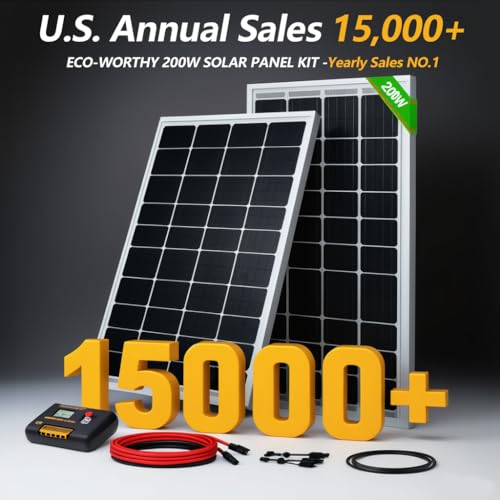
| ECO-WORTHY 200W Kit | Complete Kit | RV owners seeking a panel and controller | 200W panel, 30A PWM controller | Amazon |
| Callsun 400W Bifacial Panels | High Output | Larger roof or off-grid setups | Two 200W N-type panels | Amazon |
| Renogy ShadowFlux 200W | Shade Focus | RVs parked near trees or buildings | N-type panel, shade-focused design | Amazon |
| Renogy Portable 200W | Portable | Campers who need movable sun exposure | Foldable panel with kickstand | Amazon |
| SOLPERK 20W Kit | Battery Maintainer | Maintaining a stored vehicle battery | 20W panel with MPPT controller | Amazon |
In-Depth Reviews for best solar panels for rv
1.
ECO-WORTHY 200W RV Solar Kit
 Check Price on Amazon
The ECO-WORTHY kit pairs a 200-watt monocrystalline panel with a 30A PWM charge controller. That included controller makes it a practical starting point for an RV solar setup. The panel supports 12- or 24-volt systems, according to the product listing. Its all-in-one approach stands out for buyers who want fewer parts to source before planning a basic off-grid system.
This kit is designed for RVs, campers, caravans, and other off-grid uses. The panel is suited to a fixed install, so check your roof space and mounting plan first. The included controller helps manage charging, but you still need compatible wiring and a battery. It is best for RV owners who want a straightforward kit rather than a portable panel they move each day.
The rigid panel design is a better fit for a planned, fixed setup than frequent packing and unpacking. Confirm what mounting and wiring parts are included before installation. For buyers who need a controller and panel together, this kit can offer solid value, provided its PWM controller suits the battery system.
Why It’s Great
- Includes a 30A PWM charge controller.
- 200 watts suits modest RV power needs.
- Listed for both 12V and 24V systems.
- Monocrystalline panel design uses roof space well.
- Useful for RVs, campers, and caravans.
Good to Know
- A PWM controller may be less efficient than an MPPT controller in some setups.
- The panel needs safe mounting and compatible wiring.
- Actual output varies with sun, shade, panel angle, and temperature.
2.
Callsun 400W Bifacial RV Solar Panels
 Check Price on Amazon
This Callsun set includes two 200-watt N-type bifacial panels for a stated total of 400 watts. The listing also claims 25.6% efficiency and a dual-module parallel anti-shade design. Those features make it a high-output choice for larger RV or off-grid systems. Bifacial panels can collect light from the rear when conditions allow, but the gain depends on the install surface and light.
Two panels give buyers more layout options than one large panel, though roof dimensions still matter. The listing describes use with 12V and 24V systems and names RV, van, and marine settings. This option is best for travelers with greater energy needs and room for a larger array. Plan controller capacity, wiring, and safe mounts before connecting the panels to a battery.
The paired-panel format can suit a permanent roof setup, but it is less simple to handle than one small panel. Check the product details for mounting and cable needs before purchase. Its higher watt rating may offer value for larger systems, though real output depends on setup and sun.
Why It’s Great
- Two panels provide a stated combined 400 watts.
- N-type cells offer a high-efficiency design.
- Bifacial construction may use reflected light.
- Dual-module design offers flexible array planning.
- Listed for RV, van, marine, and off-grid use.
Good to Know
- The listing’s efficiency and shade claims are not a promise of everyday output.
- A charge controller and compatible system components may be needed separately.
- The two-panel set needs enough roof space and secure mounting.
3.
Renogy ShadowFlux 200W Solar Panel
 Check Price on Amazon
Renogy’s ShadowFlux is a 200-watt N-type panel with a stated efficiency of up to 25%. Its key feature is a design aimed at reducing the effect of partial shade from trees, buildings, roof features, leaves, or snow. This makes it worth considering for RV owners who cannot always park in full sun. It remains a solar panel, so shade can still lower energy production.
The rigid panel is intended for rooftop, marine, and home use. Its 200-watt rating makes it a possible fit for a moderate RV array, depending on battery size and daily demand. It is best for travelers who often camp where shade is hard to avoid. Plan the mount and controller carefully, and keep the panel as clear and sun-facing as conditions allow.
A fixed panel can be a tidy choice once mounted, but installation needs care and a suitable roof location. Keep the surface free of dirt and debris to help it collect light. The shade-focused design adds useful value for some routes, though it cannot replace good placement or adequate panel capacity.
Why It’s Great
- Designed to help manage some partial-shade effects.
- 200W rating suits many moderate RV setups.
- N-type cell design has a stated efficiency up to 25%.
- Made for RV, marine, and rooftop applications.
- May suit campsites where full sun is not always available.
Good to Know
- Partial-shade design does not prevent output loss in shade.
- A charge controller, wiring, and mounting plan are still important.
- The listing does not make this a portable foldable panel.
4.
Renogy Portable 200W Solar Panel
 Check Price on Amazon
This Renogy model is a foldable 200-watt N-type panel with a stated efficiency of up to 25%. A built-in kickstand helps aim it toward the sun, while USB-A and USB-C outputs add charging options for small devices. Its portable format is the main draw: unlike a fixed RV panel, it can be placed where sunlight is strongest at camp.
The foldable design suits RV travelers who want to move a panel away from roof shade or take it on camping trips. It is also listed for use with power stations, so check connector and input compatibility before buying. This is best for people who can set up and store a panel at each stop, rather than those seeking a permanent, hands-off roof array.
A portable panel is easy to put away when not in use, but it needs careful handling and dry storage. The kickstand supports quick positioning, and keeping the surface clean helps it gather light. Its value comes from flexibility, though users must plan for setup, storage, and secure placement in wind.
Why It’s Great
- Foldable format is easy to move between sunny spots.
- Kickstand supports quick panel positioning.
- USB-A and USB-C outputs are listed for device charging.
- 200W rating can suit compatible power stations.
- Useful when a fixed roof panel would sit in shade.
Good to Know
- It needs manual setup and repositioning to follow the sun.
- Check power station input limits and connectors before purchase.
- Portable panels need safe storage and should be secured outdoors.
5.
SOLPERK 20W Solar Battery Maintainer
 Check Price on Amazon
The SOLPERK kit combines a 20-watt solar panel, a smart MPPT controller, and an adjustable mounting bracket. It is made to trickle charge or maintain a compatible battery, rather than run a full RV. The waterproof design is listed for vehicle, boat, motorcycle, and marine use. For a stored RV, it can help keep a battery topped up when there is sun.
Its low-watt output makes this a different kind of RV solar product from the larger panels in this guide. It is best for owners who want battery upkeep during storage or light maintenance, not steady power for appliances. Check battery voltage and controller compatibility before connecting it. The adjustable bracket can help aim the panel, while the small size suits limited spaces.
The compact kit is easier to place than a large roof array, and the included bracket supports adjustment. Keep the panel clean and check connections as part of routine care. It can be a useful value for battery maintenance, but its 20 watts are not enough to replace a full RV solar system.
Why It’s Great
- Includes a smart MPPT controller.
- Adjustable bracket helps with panel positioning.
- Compact 20W size suits battery maintenance.
- Waterproof design is listed for outdoor vehicle use.
- Can serve RVs, boats, cars, and motorcycles.
Good to Know
- 20 watts is for battery upkeep, not powering major RV appliances.
- Confirm the kit suits your battery voltage and chemistry.
- Sunlight and parking conditions affect maintenance charging.
Final Thoughts: The Verdict
My personal top pick is the ECO-WORTHY 200W RV Solar Kit for its useful balance of panel power and an included 30A controller. It gives many RV owners a clear starting point, as long as the PWM controller and system parts match their battery. For higher power needs, Callsun’s two-panel 400W set is a strong option if you have the roof space and the right controller.
If you camp in shade, consider Renogy ShadowFlux; if you want to move your panel, choose the Renogy Portable 200W Panel. SOLPERK is for maintaining a battery, not powering a whole RV. The best solar panels for rv travel depend on your daily energy use, available space, and budget. Check compatibility before you buy, then choose the setup that fits your trips.
1 thought on “Best Solar Panels For RV: Power Your Adventures”
Comments are closed.