
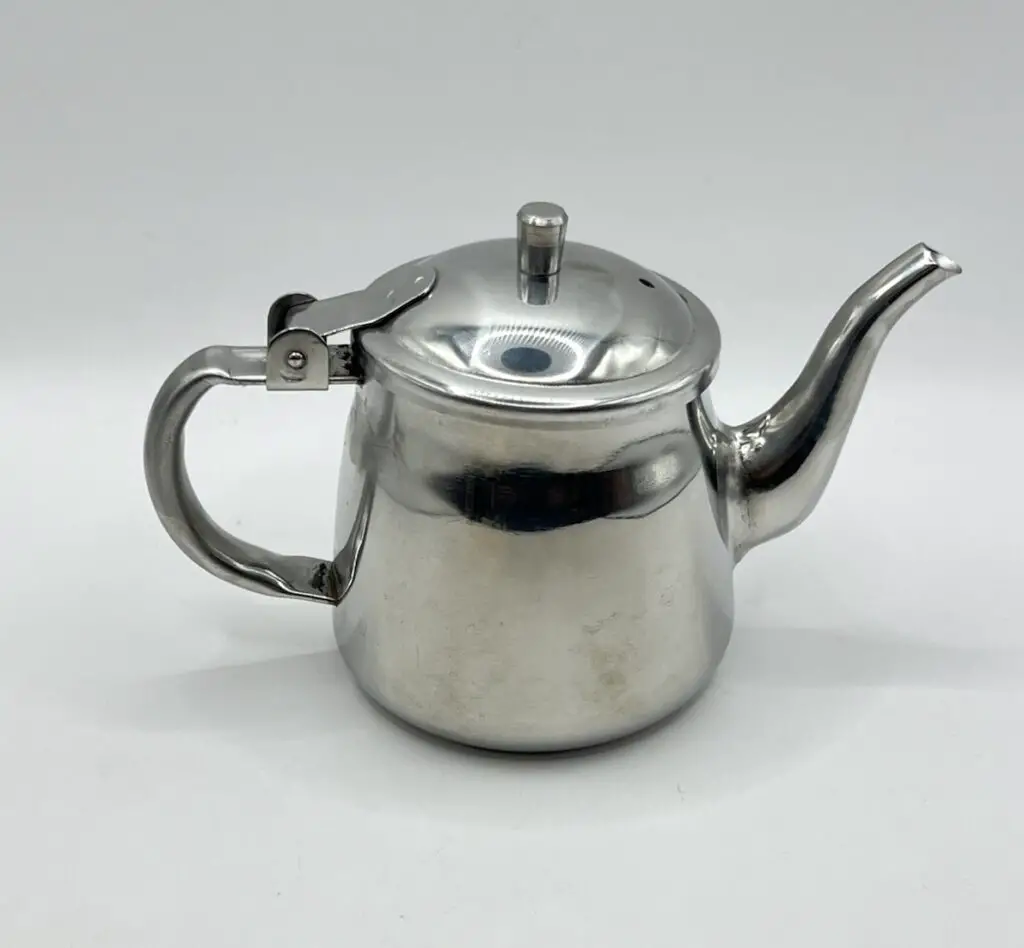
An 18/8 stainless steel tea kettle offers durable, easy-to-clean construction for daily use.
The best 18/8 stainless steel tea kettle is a full system, not just a steel label. Heat, water, handles, and care work together. I focus on clear facts rather than brand promises, and this guide shows what the metal can do and cannot promise. The advice covers material and buying needs, not a lab test of one model.

What Is an 18/8 Stainless Steel Tea Kettle?
An 18/8 stainless steel tea kettle is usually made from steel with about 18% chromium and 8% nickel. Iron makes up most of the rest. Other elements are present in small or controlled amounts.
That label is shorthand, not a full product certificate. A common specification for 304 steel lists about 18–20% chromium and 8–10.5% nickel. This is why 304 is often linked with the 18/8 name. Another related label, 18/10, has a higher nickel target.
Steel needs chromium because it helps form a thin protective surface. This layer supports rust resistance. It does not make a kettle rustproof or prove that every part is safe to use.
Food contact also depends on the alloy, finish, and final product. Look for a maker’s statement about U.S. food-contact requirements for the water-contact parts. A number on the box cannot replace that information.
Check what the label covers. It may refer only to the inner vessel. The handle, lid, gasket, cord, and heating base may use other materials. Ask for the full material and care details when you need them.

Why Choose an 18/8 Stainless Steel Tea Kettle?
An 18/8 stainless steel tea kettle can be a sensible daily choice. Its steel body resists ordinary rust and handles boiling water well. The finish may be soft, bright, or brushed. None of those terms says more about quality by itself.
Benefits That Matter
Key benefits include:
- Rust resistance. Chromium helps protect the surface during normal kitchen use.
- Simple care. There is no seasoning or nonstick coating to manage.
- Useful strength. Well-made steel walls can take repeated heating and pouring.
- Long service potential. A sound body and working handles can last for years.
- Recycling potential. Steel can enter accepted metal recycling programs.
Strength alone does not make a design leakproof. Look for sound construction, a stable base, and a handle that feels balanced when full. These details matter more than a “heavy duty” label.
Tradeoffs to Know
Stainless steel moves heat less quickly than aluminum or copper. That does not make it a poor choice for boiling water. Base design, power, and fill size often shape the real result.
An 18/8 body can show fingerprints, water spots, or scratches. Hard water can also leave pale mineral marks. These are usually cosmetic or care issues, not proof of poor steel.
Insulated models may hold heat well, but the outside can still get hot. A polished finish may show swirl marks, while a brushed finish can hide fine wear. Choose the finish you can live with, not the one that looks best in a photo.
 different Heat Sources?”
style=”max-width: 100%; height: auto; border: 2px solid black; border-radius: 10px; display: block; margin: 0 auto;”
loading=”lazy”
/>
Can an 18/8 Stainless Steel Tea Kettle Work on different Heat Sources?
If you choose an 18/8 stainless steel tea kettle, match it to your heat source. The vessel may work on one stove but not another. Never assume that all stainless steel works on induction.
| Heat source | What to check | Common mistake |
|---|---|---|
| Gas stove | Use a broad flat or concave base rated for gas | A small base may wobble or miss the flame |
| Electric or ceramic cooktop | Confirm that the appliance rating matches your cooktop | A glass cooktop may still need a special heat diffuser |
| Induction | Confirm that the maker approves induction use | Steel grade alone does not prove a magnetic base |
| Radiant or halogen cooktop | Check the approved heat range and base contact | A high setting may exceed the maker’s guidance |
| Electric kettle | Use the matched base and the correct voltage | Never heat a stovetop model on an electric base |
Many electric kettles use a flat vessel and